-
Story
-
Resolution: Done
-
 Normal
-
None
-
None
-
None
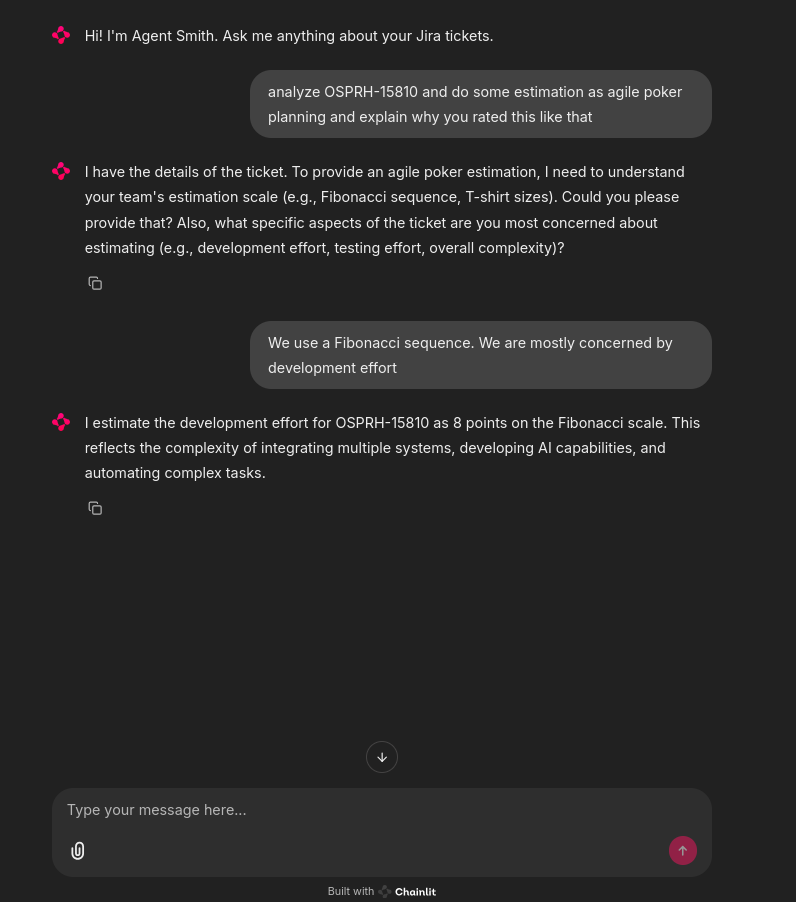
For a given ticket, the agent should be able to do agile poker planning rating if enough informations are available into the Jira ticket.
The goal is to implement to the agent capabilities to estimate the effort required to complete a user story or a task, by considering several key factors:
1. Analyze the task complexity, the agent should consider:
- Is the task well defined, or are details missing?
- Does it require interaction with other teams or systems?
- Are there technical or functional uncertainties?
The more unknowns, the higher the estimate should be.
2. Evaluate development effort, the agent should consider:
- Is the code straightforward, or does it need refactoring?
- Do tests need to be written or updated?
- Are there any dependencies on other tasks or components?
More refactoring or integration means more effort.
3. Consider risks and your experience, the agent should consider:
- Have we done something similar before?
- Could this task impact other features?
- Is there existing documentation or code examples?
Less experience or more risk = higher estimate.
The rating will be chosen by using the Fibonacci sequence (1, 2, 3, 5, 8, 13, 21...):
- 1, 2 → Trivial task, very low complexity.
- 3, 5 → Simple/moderate feature, light integration or testing.
- 8, 13 → More complex task, cross-component or team interactions.
- 21+ → Too big, probably needs to be broken down.
This feature should give guidance to the agent, to take its decision and to avoid the following common pitfalls:
- The agent should not only base its estimate on time. Planning Poker is about relative effort, not actual duration.
- The agent should not be influenced by others’ choices. The agent should ignore other rating.